The Complete Guide to SosoActive: Meaning, Legitimacy, and Use
You search “SosoActive” expecting a quick answer. Instead, you land on pages that say different things. One calls it a media site. Another calls it a platform. A third makes it sound like a big online idea. That’s frustrating.
You’re not confused because it’s complicated. You’re confused because the answers don’t match. Here’s the truth. SosoActive isn’t explained clearly online. Different websites describe it in different ways. Some stick to facts. Others stretch the meaning to attract clicks. That’s why the search results feel messy.
So what should you actually believe? In this guide, I’ll break it down in plain, simple words. You’ll learn what SosoActive most likely is, what’s still unclear, and how to judge it for yourself. No fluff. No guessing. Just a clear explanation you can trust.
A Simple Answer: What SosoActive Actually Is
SosoActive is usually described as a digital content or media-related name online. That sounds simple, but the reality is a bit messy. Different websites explain it in different ways, which makes it harder for you to get one clear answer. Some treat it like a website where articles are published. Others describe it like a broader brand or even an idea around online activity and engagement. This mix of explanations is the main reason people get confused when they search for it.
To make it easier, think of SosoActive as something connected to online content. It sits in the same space as blogs, media sites, or content hubs. You visit, read something useful or interesting, and then move on. But unlike well-known platforms, it does not have one clear identity everywhere. That lack of clarity is the real issue. According to Google Developers’ content guidelines, clear identity builds trust. When that clarity is missing, users start to question what they’re seeing.
The most common definition you’ll see online
Most sources describe SosoActive as a content-focused digital presence. In simple terms, that means it shares articles, updates, or general media content across different topics. It doesn’t stick to just one niche, which is why it feels broad and sometimes unclear. When you visit a site linked to SosoActive, you’ll likely find a mix of topics rather than one focused category.
Here are some common areas it covers:
- Business
- Tech
- Lifestyle
- Culture
This makes it feel like a general blog or media hub. In real life, you might land on a page, read an article about business tips, then see another one about health or technology. That kind of variety is common in content websites, but it can also make the brand harder to define.
The challenge is that there is no single official explanation repeated everywhere. Each site explains it in its own way, which adds to the confusion. Some pages stay close to facts, while others expand the meaning to make it sound bigger or more important than it is.
Why it’s described in different ways (media, platform, or brand)
This is where things start to feel confusing. You might see one article calling SosoActive a media brand, while another calls it a platform for creators. Some even describe it like a bigger idea about online engagement. These are not the same things, which is why the mixed descriptions can throw you off.
The main reason for this is simple. There is no strong, unified explanation that everyone follows. So writers fill in the gaps based on their own understanding or goals. Some focus on content, so they call it a media brand. Others want to attract creators, so they frame it like a platform. A few stretch it further and turn it into a concept.
Here’s a simple way to picture it. Imagine a shop with no signboard. One person walks in and thinks it’s a grocery store. Another thinks it’s a bakery. Both might see parts that support their view, but neither gets the full picture. That’s exactly what’s happening here.
Many websites also try to rank on Google, so they shape their explanation to match what people are searching for. As noted by Search Engine Journal (2024), content often gets adjusted to fit search intent, even if it makes the topic less clear.
What We Know vs What’s Still Unclear
Before you trust any information about SosoActive, you need to separate facts from guesses. That’s the easiest way to avoid confusion. When a topic is explained in many different ways online, not everything you read will be equally reliable. Some parts are based on repeated patterns, while others are based on assumptions or stretched ideas.
Think of it like hearing a story from different people. If everyone agrees on certain points, those are likely true. But when details start changing, you know something is unclear. The same logic applies here. SosoActive is not completely unknown, but it is not clearly defined either. That puts it in a gray area where you have to be careful.
A smart approach is simple. Look for what stays consistent across sources, and question what keeps changing. This method is also supported by content quality advice from HubSpot and Google, where consistency and clarity are key signals of trust.
Things that appear consistent across sources
When you look across different websites, a few ideas show up again and again. These repeated patterns help build a basic understanding of SosoActive. Even if the full picture isn’t clear, these points give you a starting place.
SosoActive is often linked to:
- Digital content
- Media-style publishing
- Online engagement
These three ideas appear in many explanations. That matters because repetition across sources usually points to something real. It doesn’t mean every detail is correct, but it shows a shared direction. In simple terms, most pages agree that SosoActive is connected to content and online activity.
You can think of it like multiple people describing the same place. They may use different words, but if they all mention similar features, you can start forming a clear image in your mind. That’s what’s happening here.
Also, SosoActive clearly exists as a searchable topic. It shows up on many websites, which means it has a visible digital footprint. According to HubSpot (2023), repeated mentions across different platforms often signal that something has real presence online.
Things that are still vague or debated
Now let’s look at the confusing side. Even though some things repeat, many details about SosoActive are still unclear.
Here are some of the biggest unanswered questions:
- Is it a company or just a name used by many sites?
- Does it have one official website or many versions?
- Is it a real platform for users or just content branding?
Different websites give different answers to these questions. That creates doubt because you don’t know which version is correct. Some pages sound very confident, but they don’t always show proof. Others stay vague, which doesn’t help either.
Think of it like trying to follow a map with missing pieces. You can still move forward, but you’re not fully sure if you’re going the right way. That’s exactly how SosoActive feels when you research it online.
This problem is common in SEO-driven content. Some articles add extra claims just to stand out or rank higher. Forbes (2023) points out that unclear brand identity is a common issue in digital spaces, especially when multiple sources try to define the same thing in different ways.
Why SosoActive Search Results Are So Confusing
You’re not confused by accident. The search results for SosoActive are genuinely messy. When you type it into Google, you expect one clear answer. Instead, you get different explanations that don’t fully match. That can make you question what’s actually true.
This happens when a topic does not have one strong, clear identity online. Instead of one trusted source leading the conversation, many smaller pages try to explain it in their own way. Each one adds a slightly different angle, which creates a mixed picture.
In simple terms, Google is showing you everything it can find, not just one final answer. That’s why the results feel scattered. Some pages focus on content, others on branding, and a few try to stretch the idea even further. When all of these appear together, it becomes harder for you to connect the dots. Understanding why this happens helps you read those results more carefully instead of getting overwhelmed by them.
Different pages targeting different meanings
One big reason for the confusion is that each page is trying to answer a slightly different question. Even though they all use the word “SosoActive,” they are not always talking about the same thing in the same way.
Some pages explain it as a brand. Others describe it as a website where content is published. A few go even further and turn it into a general idea about online engagement or digital activity. These are very different meanings, but they all show up under the same search term.
This creates a situation where you don’t get one clear answer. Instead, you see multiple angles at once. It’s like asking a simple question and getting three different explanations that don’t fully match.
A helpful way to understand this is with a simple example. Imagine searching for “Apple.” One result talks about fruit. Another talks about the tech company. Both are correct, but they answer different meanings of the same word. That’s exactly what’s happening with SosoActive.
SEO-driven content vs real information
Another reason behind the confusion is how online content is created. Not every article is written just to help you understand a topic. Many are written to rank on Google and attract clicks. This often leads to content that looks helpful but is not always clear or precise. Writers may expand topics, add extra details, or stretch meanings to match popular searches. That can make the explanation feel bigger, but not necessarily clearer.
Here’s what usually happens:
- Writers use popular keywords
- They expand topics to attract traffic
- They sometimes add assumptions
This doesn’t mean the content is completely wrong. But it can mean the explanation is less focused. You may read a full article and still not get a direct answer. Search Engine Journal (2025) points out that topics with unclear identity often attract “search-first” content instead of “user-first” content. That means the goal becomes ranking higher, not explaining better. In real life, this feels like reading reviews that sound detailed but don’t actually answer your question.
Why Google hasn’t settled on one clear answer
Google’s goal is to show the best and most helpful result. But it can only do that when clear signals exist. For SosoActive, those signals are weak and mixed.
Here’s what Google is dealing with:
- No single dominant source
- No widely accepted definition
- Different content types competing
Because of this, Google cannot confidently pick one “best” answer. So instead, it shows a mix of results from different angles. That’s why you see variety instead of consistency. According to Google’s own guidelines (2024), when a topic lacks clear identity, search results often become diverse. This is not a mistake. It’s how the system handles uncertainty. Until one strong, well-explained source stands out and becomes widely trusted, this situation is likely to continue. That means the confusion won’t go away quickly.
What SosoActive Seems to Offer or Publish
Let’s take a closer look at what SosoActive actually does. This is where things start to feel a bit clearer, even though some confusion still exists. When you go through different sources, one pattern shows up again and again. SosoActive is mostly linked to publishing content rather than offering a specific tool or service.
In simple terms, it behaves like a place where information is shared. You visit, read something useful, and then leave. There’s no strong sign that it works like an app, software, or interactive platform where you actively do something. Instead, it feels more like a reading experience.
That said, the lack of a single clear explanation still creates doubt. Some pages try to describe it in broader ways, which can make it seem more complex than it actually is. To understand it properly, you need to focus on what shows up consistently rather than what sounds impressive.
Content topics (media, business, lifestyle, tech, etc.)
When you explore different mentions of SosoActive, you’ll notice that it does not stick to just one topic. Instead, it covers a wide range of everyday subjects. This is a strong sign that it works like a general content site rather than a focused niche platform.
Some of the most common topics include:
- Business and finance
- Technology
- Lifestyle and wellness
- Entertainment and culture
This mix makes it feel like a digital magazine or blog where you can find a bit of everything. In real life, this means you might land on one article about business tips and then see another about health or trending topics. It’s designed more for reading and exploring than for deep specialization.
The downside of this approach is that it can feel less defined. When a site covers too many areas, it becomes harder to understand its main purpose. HubSpot (2024) explains that broad-topic sites often struggle with clear positioning because they try to serve too many interests at once.
Is it a content site, service, or something else?
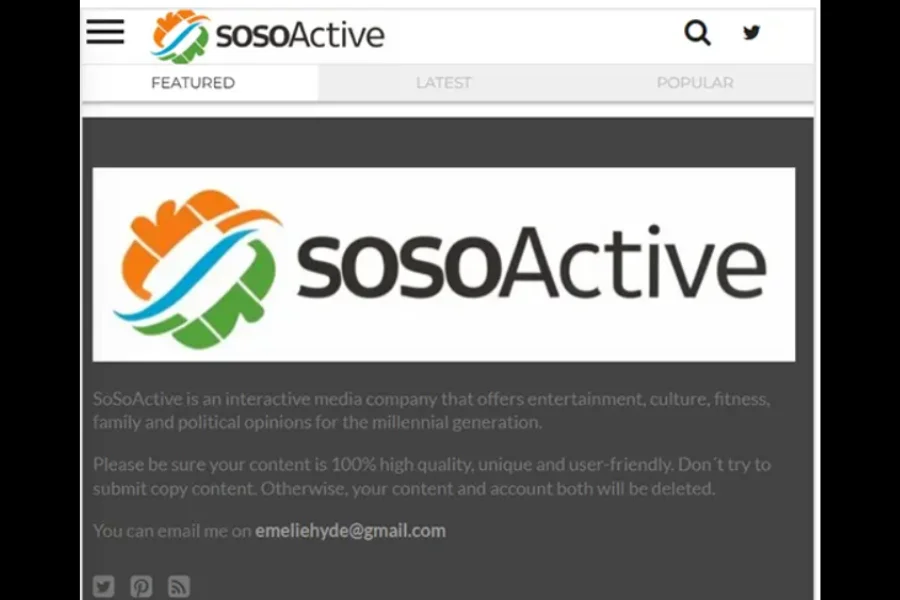
This is where many people start to feel unsure again. Based on most available information, SosoActive behaves like a content site. You read articles, but you don’t see strong signs of tools, dashboards, or user-based features that you’d expect from a platform.
However, some pages describe it differently. They mention things like digital growth, marketing, or brand support. That can make it sound like a service or a platform, even if there is little clear proof behind those claims. These mixed descriptions create confusion because they point in different directions.
A simple way to understand this is:
- If it mainly publishes articles → it’s a content site
- If it offers tools or services → it’s a platform
From what you can actually observe, SosoActive fits more into the first category. It looks and behaves like a place where information is shared, not where users actively perform tasks or access services. Still, since different sources describe it in different ways, it’s important not to assume too much without clear evidence.
Is SosoActive Legit or Not?
This is the question most people really want answered. After seeing mixed explanations, it’s normal to wonder if SosoActive is actually legit or just another confusing name online. The honest answer is not a simple yes or no. It sits somewhere in the middle, and that’s why it needs a careful look.
When you judge something online, you shouldn’t rely on just one page. You should look at patterns. Does it show up in multiple places? Does it stay consistent? Does it look active? These small signals help you decide if something is worth trusting.
SosoActive does show some real presence online. But at the same time, it lacks clear identity in many areas. That combination is what makes people unsure. It’s not about spotting a scam. It’s about understanding how much confidence you should place in it.
Signs that make it look credible
There are a few positive signs that make SosoActive look real. These are basic signals that usually show something has an actual presence online. While they don’t prove everything, they do give a starting level of trust.
Some of the main signs include:
- It appears across many websites
- It has consistent topic themes
- It shows ongoing content activity
When something shows up in multiple places, it usually means it has some level of recognition. It’s not just a one-time mention. The repeated connection to content and media topics also adds a layer of consistency, which is important for trust.
In real life, this is like seeing a shop open every day. You may not know everything about the owner, but you can see that it exists and operates regularly. That builds basic confidence. Google’s trust guidelines also highlight consistency and presence as important signals. When a name keeps appearing with similar themes, it suggests a real digital footprint.
Red flags or reasons for doubt
Now let’s look at the concerns. These are the areas where SosoActive starts to feel unclear. They don’t prove anything negative, but they do make you pause and think more carefully.
Some key concerns include:
- No clear official identity
- Different descriptions across sites
- Lack of strong ownership details
These issues matter because trust online often depends on clarity. When a brand or platform is real and well-established, it usually has a clear identity. You know who runs it, what it does, and how it works. With SosoActive, those details are not always easy to find.
Think of it like visiting a store with no clear name or branding. You might still go inside, but you’ll be more careful about what you trust or buy. That same feeling applies here. Forbes (2024) points out that unclear branding often leads to hesitation. When people don’t fully understand what something is, they naturally become cautious.
A simple trust verdict
So, what’s the final answer? Is SosoActive legit? The most honest answer is yes—but with caution. It is real enough to exist, appear in search results, and be discussed across multiple websites. That means it’s not something completely made up. However, it is not clearly defined or fully transparent, which means you should not trust every claim you see about it.
The smart approach is simple and practical. Focus on what you can actually verify. If something looks clear and supported, you can consider it. If something feels vague or exaggerated, it’s better to question it.
In real life, this is how you handle anything uncertain. You don’t ignore it, but you also don’t accept everything without thinking. By staying aware and asking simple questions, you can avoid being misled and make better decisions.
How to Evaluate SosoActive Without Getting Misled
When a topic feels unclear, the best thing you can do is slow down and evaluate it step by step. SosoActive is one of those cases where quick assumptions can lead to confusion. So instead of trusting the first explanation you read, you need a simple way to judge what’s real and what’s not.
The goal here is not to prove everything wrong. It’s to stay balanced. You want to understand what is clearly supported and what is just added to fill gaps. This approach helps you avoid being misled by content that sounds confident but lacks proof.
In real life, you already do this. When you buy something online, you don’t trust the first review you see. You compare, check, and think before deciding. The same mindset works here. By asking a few simple questions and focusing on what you can actually verify, you can make sense of SosoActive without getting lost in mixed explanations.
Check what is real vs assumed
The first and most important step is to separate facts from assumptions. Many articles mix what is clearly visible with what the writer believes or guesses. If you don’t spot that difference, it’s easy to get confused.
Start by asking yourself:
- What can I clearly see?
- What is the writer assuming?
For example, if a page calls SosoActive a “platform,” don’t just accept it. Check if there is actual proof. Can users sign up? Is there a dashboard or tool? If not, then it may just be an assumption, not a fact.
This habit is very practical. In real life, it’s like checking a product before buying it instead of trusting the label alone. Over time, this way of thinking becomes natural. You stop getting pulled in by big claims and start relying on what you can verify yourself.
Questions you should ask before trusting any page
Before you trust any explanation about SosoActive, take a moment to ask a few simple questions. These questions act like a quick filter. They help you decide whether the content is reliable or just trying to sound convincing.
Here are some useful questions to ask:
- Does this page show proof?
- Is the explanation consistent?
- Does it match other sources?
If a page makes strong claims but doesn’t show any clear evidence, that’s a sign to be careful. If the explanation changes from one section to another, that’s another warning. And if it doesn’t match what other sources are saying, it’s worth double-checking.
Think of it like reading product reviews before making a purchase. If all reviews say different things, you don’t rush into a decision. You pause and look deeper. This small step can save you from believing information that sounds good but isn’t fully reliable.
How readers, creators, and marketers should view it differently
Not everyone looks at SosoActive the same way. Your perspective depends on what you need from it. This is important because one explanation may not fit everyone.
Different people usually have different goals:
- Readers want clarity and trust
- Creators want visibility and reach
- Marketers want traffic and SEO value
If you’re a reader, your focus should be on understanding what SosoActive actually is and whether the information is reliable. If you’re a creator, you might care more about whether it offers exposure or publishing opportunities. And if you’re a marketer, you may see it as a chance to target a weak search topic and gain traffic.
This is why opinions about SosoActive can vary so much. Each group looks at it through its own lens. In real life, it’s like visiting the same place for different reasons. One person goes to learn, another to promote, and another to analyze.
A Quick Look at SosoActive’s Background
When something feels confusing today, looking at its past can help a lot. The same goes for SosoActive. Its history is not fully documented in one place, but there are enough clues to understand where some of the confusion comes from. Many digital topics don’t start with a clear identity. They grow over time, and different people describe them in different ways.
SosoActive appears to be one of those cases. It seems to have started as part of the digital content space, especially around media and culture. Over time, more pages mentioned it, each adding their own interpretation. This created layers of meaning instead of one clear definition.
Understanding this background helps you make sense of why search results look the way they do today. It’s not random. It’s the result of how the topic has been described and reshaped over time.
Its early presence in digital media
SosoActive appears to have roots in earlier digital media spaces. Many references connect it to content related to culture, entertainment, and general online publishing. This suggests that it likely started as part of a content-driven environment rather than a tool or service.
In simple terms, it seems to have been linked to the kind of websites people visit to read articles, explore trends, or stay updated on different topics. Back then, digital media was growing fast, and many platforms focused on sharing content across multiple areas instead of sticking to one niche.
This early connection to media helps explain why SosoActive is still associated with content today. Even if the details are not fully clear, the pattern points toward a publishing-style identity rather than something technical or service-based. In real life, this is like an old magazine that people still mention years later. Even if it changes or fades, its name continues to appear because it once had a presence.
Why older content still affects today’s confusion
One big reason for the confusion around SosoActive is that old content never really disappears. Once something is published online, it can stay there for years. That means older explanations continue to show up alongside newer ones, even if they don’t fully match.
Because of this, you may come across:
- Outdated explanations
- Mixed definitions
- Old vs new interpretations
This creates a layered kind of confusion. Instead of seeing one clear answer, you see multiple versions from different points in time. Some pages may describe SosoActive based on how it was seen years ago, while others try to explain it in a more modern way.
Think of it like using two maps at once—one old and one new. Both show the same place, but the details don’t fully match. That makes it harder to decide which one to trust. Google does not always remove older content, so all of these versions remain visible. This is a normal part of how the web works, but it can make unclear topics even harder to understand.
Final Words
When you search “SosoActive,” the results can feel all over the place. One page calls it a media site, another a platform, and a third a broader online idea. The reason is simple: there’s no single clear explanation online. Some sources stick to facts, while others stretch the meaning to rank on Google. That’s why the search results feel messy.
Most evidence shows that SosoActive is linked to digital content and media-style publishing. You’ll see articles covering business, tech, lifestyle, and culture. It behaves more like a content site or blog than a tool, app, or full platform. Its early presence in digital media means older content still appears online, adding to the confusion.
It’s real enough to exist, but its identity isn’t fully clear. The safest approach is to trust what you can verify, question assumptions, and consider your purpose—whether reading, creating, or marketing—before drawing conclusions.
Come back to Arcadia Movers for fresh stories that actually matter to you.